My idea of a bean-to-cup coffee machine used to be a sad, vending machine-style, plastic cup affair.
You know the type the ones in office break rooms that dispense something vaguely coffee-flavoured alongside a cuppa soup option.
But bloody’ell, things have changed.
Bean-to-cup machines have genuinely got good over the last few years. With the specialty coffee boom and people wanting proper coffee at home without spending ten minutes dialling in shots every morning, manufacturers have finally started taking these machines seriously.
Now, before we go any further, let’s clear something up because there’s a lot of confusion in the market: what actually IS a bean-to-cup coffee machine?
But first of all…
AUTHOR: TOM SAXON
Why trust me
I’m Tom Saxon, and I’ve been working in the coffee industry for over 10 years as a barista in Australia, on coffee farms in South America, roasting in the UK, and running Batch Coffee Club since 2020.
But more importantly for this article: I’ve actually used these machines. Not just read the spec sheets, but ground beans through them, pulled shots from them, cleaned the bloody brewing units, and dealt with their quirks.
I’m a coffee snob in recovery. I used to be the type who’d only drink single-origin pour-overs and scoff at anything automated. But I’ve come to respect what modern bean-to-cup machines can do. They’re not going to match a skilled barista on a £10k La Marzocco, but they’ll make a perfectly good flat white at 6am when you can’t be arsed to dial in your grinder.
Checkout our award-winning coffee subscription and my book The Home Barista.
BEst Bean To Cup Overview
BEST UNDER £400: De’Longhi Magnifica Evo Next
BEST UNDER £700: Melitta Barista TS Smart
BEST FOR BEGINNERS: De’Longhi Magnifica Evo
BEST FOR MILK DRINKS: Melitta Barista TS
BEST COMPACT OPTION: Gaggia Brera
What IS (and ISN’T) a Bean-to-Cup Machine
The confusion exists because marketing departments love using “bean-to-cup” to describe any machine that grinds beans.
But if you’re pulling a portafilter in and out, tamping, and dealing with puck prep, you’re using a traditional espresso machine – not a bean-to-cup.
Why does this matter? Because if you’re looking for convenience (which is the whole point of bean-to-cup), you don’t want to end up with a machine that requires learning barista skills.
Right, now that’s sorted – let’s talk about the actual bean-to-cup machines.
They enable you to produce the same quality coffee consistently without learning a new skill.
Best Bean To Cup Coffee Machines 2025
Just so you know. When you buy via the links on our blogs, we may earn an affiliate commission at no cost to you. Learn More
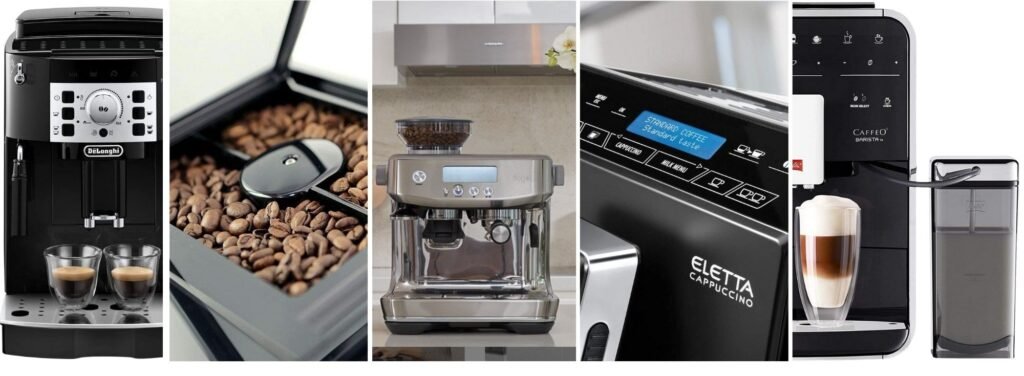
1. De’Longhi – Magnifica Evo Next
- Type: Fully automatic bean-to-cup
- Grinder: Stainless steel burr grinder, 13 settings
- Drinks: Espresso, Americano, Coffee, Cappuccino, Latte, Flat White, Milk Foam
- Milk System: LatteCrema automatic milk frother
- Water Tank: 1.8L (front access)
- Bean Hopper: 250g
- Pressure: 15 bar
- Display: 3.5″ full-touch colour display
- Dimensions: 24cm (W) x 44cm (D) x 36cm (H)
- Price: £450-550
- Value: ★★★★★★★★★☆
For me, the Magnifica Evo Next is the best all-round bean-to-cup machine you can buy for under £500. De’Longhi have absolutely nailed the balance between ease of use, coffee quality, and features – and they’ve done it at a price that won’t make you wince.
This is the newer iteration of the Magnifica range, and it’s what the legendary ECAM 4200 would be if it were released in 2024. That’s high praise, by the way – the 4200 was the best-selling bean-to-cup in the UK for years.
What’s Actually Good About It
The touchscreen is brilliant. Not just “good for a coffee machine” – actually brilliant. It’s a 3.5″ colour display that’s responsive and intuitive. You can save your favourite drinks, adjust strength and temperature, and the interface doesn’t feel like it was designed in 2005 (unlike some competitors I could mention).
De’Longhi have included something called “My LatteArt” which sounds gimmicky but is actually quite clever you can adjust the milk-to-coffee ratio, which means you can dial in exactly how you like your flat white. Most bean-to-cup machines give you preset ratios that you’re stuck with.
The LatteCrema system produces genuinely good milk foam. It’s not barista-level microfoam that you can pour latte art with, but it’s creamy, consistent, and miles better than the froth you get from basic steam wands or those terrible cappuccinatore attachments.
The automatic milk jug is also a godsend for convenience you can keep it in the fridge between uses, which is more hygienic than machines where the milk sits in tubes inside the machine all day.
Espresso quality is consistently good. I’ve pulled hundreds of shots through De’Longhi machines over the years (we’ve tested them extensively for Batch), and they’re reliable. The 13-setting burr grinder gives you enough adjustment range to dial things in properly, and the 15-bar pump delivers proper extraction.
Will it match a £2000 traditional espresso setup with a separate grinder? No. But it’ll make a flat white at 6:30am that you’ll actually enjoy, and you won’t have spent ten minutes faffing with puck prep.
What You Need to Know (The Less Good Bits)
It’s not small. At 44cm deep, you need decent size worktop space for this. It’s not a machine you can tuck into a corner or squeeze next to your toaster. Measure your space before buying.
The bean hopper capacity is only 250g. This means you’re refilling it weekly if you’re a heavy coffee drinker.
The milk system needs cleaning properly. The LatteCrema jug is easy to clean – you literally rinse it under the tap – but you do need to actually do it. If you’re the type who leaves milk sitting around, you’ll grow interesting biology experiments. (This applies to all bean-to-cup machines with milk systems, not just De’Longhi.)
It’s not particularly quiet. The grinder is about as loud as a decent hair dryer. If you’re making coffee at 6am while your partner’s still asleep, they’re waking up. There’s no getting around this – all bean-to-cup machines with burr grinders are fairly loud.
Who It’s Actually For
Perfect for: Someone who wants excellent coffee with minimal faff. You’re happy to spend £500 on convenience. You drink multiple coffees a day (mostly milk-based drinks like lattes and flat whites). You want something that looks modern on your worktop.
Not ideal for: People short on worktop space. Black coffee purists who never touch milk. Anyone on a tight budget (there are cheaper options that make 85% as good coffee). People who want complete manual control over every variable.
The Honest Assessment
If I were spending my own money on a bean-to-cup machine today and had a £500 budget, I’d buy this. It’s the machine I’d recommend to my parents, my mates, and pretty much anyone who asked.
De’Longhi have figured out what matters: consistent espresso quality, good milk frothing, and an interface that doesn’t make you want to throw the machine out the window. They’ve skipped the gimmicks (no app control, no voice commands, no bluetooth) and focused on making a machine that just works.
The Magnifica Evo Next represents the sweet spot in the bean-to-cup market – enough features to be convenient and flexible, not so many features that you’re paying for stuff you’ll never use.
2. Melitta – TS Smart
- Coffee Menu – Espresso, Milk Based Espresso*, Americano.
- Dimensions: H37 x W26 x D47cm
- Weight: 11kg
- Tank Capacity: 2 litres
- Features: App, Two Hoppers, Adjustable Grind
- Value – ★★★★★★★★☆☆
*Drinks such as Cappuccinos, Lattes, Flat Whites etc.
If you’re looking to seriously minimise effort or love a new gadget then the Melitta TS Smart may be your calling.
By downloading the Melitta app you can control the Barista machine from anywhere within bluetooth range which means you can now make a coffee in bed as well.
There are a couple of things other than the obvious technology that sets this machine apart from the rest.
Firstly it essentially has two bean hoppers, this is great if there is a decaf drinker in the house or you’re partial to a milk based coffee using espresso beans and also a single origin espresso or long black.
It also has a hatch where you can lob pre-ground coffee if for some reason you’re not into beans.
Secondly it has a slider that controls how coarse you want the grind. This is something that you don’t often see on Automatic espresso machines but something that gives you a little bit of optional control.
(The ground coffees coarseness is a daily battle for the professional barista and has to be adjusted constantly.)
The Melitta TS Smart is really easy to clean and all the parts are easy to remove, it will also tell you exactly when tanks need emptying and beans need topping up.
It does have some quirks with the technology as most app based smart products do (I’ve certainly lost a few hairs because of smart printers).
It is also rather large when you have the detachable milk container so you need a fair bit of space on your work surface.
All in all it looks great and is pretty bloody clever.
3. De’Longhi – Eletta
- Coffee Menu – Espresso, Milk Based Espresso*, Americano.
- Dimensions: H36 x W46 x D46cm
- Weight: 11 kg
- Tank Capacity: 2 litres
- Features: Coffee Type Options, Detachable Milk Canister, Easy Clean
- Value – ★★★★★★★★☆☆
*Drinks such as Cappuccinos, Lattes, Flat Whites etc.
As far as bean to cup machines go the Delonghi Eletta has all sorts of functions, makes pretty good coffee and gets an extra point for looking sharp.
The Elleta has a hot water spout that can be removed and replaced with a milk container/steamer. The adjustable dripper is great for larger glasses if you’re the sort to make lattes at home.
Various functions include steaming the milk for different coffee types (flat white, latte and macchiato), output of the coffee (small, long, double) and programming your own ‘My Coffee’ function which lets you dictate how much espresso you’d like.
When you’re ready to make your desired coffee simply aim the milk pourer into your favourite coffee cup and sit back and watch the magic happen.
Cleaning is easy with a push of a button, water is flushed through the tubes then detach the milk container and place in the fridge.
You may find that the buttons are a little sensitive and you accidentally graze past one and accidentally start making a cappuccino, it’s something that you will get used to though.
The grinder as with any grinder is pretty loud and also doesn’t let you know when it’s running low as it is contained inside the machine just make sure you keep an eye on this as it will start making a coffee without enough coffee beans.
4. Smarter – Coffee Maker
- Coffee Menu – Filter Coffee.
- Dimensions: 42.5cm x 26.5cm x 20.5cm
- Weight: 8kg
- Tank Capacity: 1.5 litres
- Features: Smart Technology, Manually Adjustable, Interchanging Panels
- Value – ★★★★★★★☆☆☆
Alexa brew me a coffee is now a thing.
The Smarter coffee maker is, as you may have guessed one of the sharpest tools in the shed. Simply download the Smarter coffee app and communicate directly with the machine.
The Smarter coffee maker filter is all about convenience and eliminating time stood around waiting for the coffee to brew.
Select ‘Home Mode’ and the drip coffee machine will start brewing your coffee the second you walk through the door or opt for an extra few minutes in bed while coffee is brewing through your snooze alarm.
Although the coffee you will brew with this machine is only filter coffee (no espresso or milk based espresso drinks like lattes) it executes the extraction each time.
Alter and adjust each variable either manually via the LCD screen or on the app.
Style has not been forgotten with the Smarter drip filter coffee machine either, each unit comes with interchangeable colour panels for the front, choose between a black, red or white filter coffee machine to match your kitchen.
5. Beko – Bean to Cup
- Coffee Menu – Espresso, Milk Based Espresso*, Americano.
- Dimensions: H23.8 x W35.1 x D43cm
- Weight: 9kg
- Tank Capacity: 1.8 litres
- Features: One Touch Coffee, Milk Frother, Easy Clean
- Value – ★★★★★★★☆☆☆
*Drinks such as Cappuccinos, Lattes, Flat Whites etc.
The Beko is a slick and one of the best budget bean to cup machines on the market.
Although Beko are not usually amongst the brands you would associate with home coffee machines, their bean to cup coffee machine is certainly work a look.
The Beko has been designed with a minimalistic approach and a smooth polished exterior. The LCD screen on the top of the machine makes it easy to select the function that best suits you.
Simply fill the coffee bean hopper and water tank and turn the machine on.
It is important to pull a couple of shots of coffee first by selecting one of the preprogrammed single or double shot buttons. You should then be able to manually adjust the grind size inside the hopper with the grind size dial.
One of the biggest selling points of the Beko coffee machine bean to cup for me is the Small footprint.
Many of these machines take up a huge amount of space on your work-surface, the combination of grinder and coffee maker usually makes for a bulky design. Only measuring 236mm wide the Beko will squeeze onto most kitchen work surfaces elegantly.
6. Gaggia – Brera
- Coffee Menu – Espresso, Milk Based Espresso*, Americano.
- Dimensions: H31 x W25 x D44cm
- Weight: 9kg
- Tank Capacity: 1.2 litres
- Features: Pre-Infusion, Steamer, Easy Clean
- Value – ★★★★★★★☆☆☆
*Drinks such as Cappuccinos, Lattes, Flat Whites etc.
The Gaggia Brera is a bit of a classic in the bean to cup coffee machine world.
It has been around for a few years and is a solid choice when you’re looking for longevity.
The Gaggia’s simplicity is a selling point. Turn the machine on and wait a minute for it to heat up then press one of the preprogrammed buttons for either a single or double shot.
A great feature of the Brera is that all the shots have a pre-infusion step and is something that is rarely seen on bean to cup machines.
The brewing mechanics are easy to pull out of the back of the machine and clean alongside the knock tube located in one of the front drawers.
The machine doesn’t have any of the smart features that other automatic machines have but it is still pretty switched on as it will let you know when you need to descale or empty and fill various compartments.
The frothing wand maybe isn’t quite as powerful as some other domestic espresso machines, especially some of the semi-automatic ones. This is because the boiler tank size is pretty small.
How did the Gaggia Brera sound to you?
7. Krups – Evidence
- Coffee Menu – Espresso, Milk Based Espresso*, Americano.
- Dimensions: H37 x W24 x D36cm
- Weight: 9.5kg
- Tank Capacity: 2.3 litres
- Features: Coffee Presets, Automatic Milk Texturing.
- Value – ★★★★★★☆☆☆☆ *Drinks such as Cappuccinos, Lattes, Flat Whites etc.
You are spoilt for choice with the 17 preset coffee options you can choose from with the Krups Evidence One.
Load the machine like many of the others by pouring coffee beans into the top hopper and don’t forget to fill the water tank at the back.
The milk is automatically textured in the Krups Evidence One by placing the milk tube into a carafe of milk placed at the side of the drip tray, the machine will steam and pump the milk when needed.
Select your coffee by using the intelligent touch screen where you can save your favourite brew and customise each extraction.
It may take some dialling in and some compromise when extracting your espresso as the Kruups Evidence one only has 5 grind settings, so you may have to dose a little higher.
The machine is also fairly quiet when brewing and texturing the milk, a selling point for early risers. All in all a pretty well made super automatic bean to cup coffee machine which for us is the best one cup bean to cup for one.
Is this the bean to cup coffee maker you have been looking for?
What Is A Bean To Cup Coffee Machine?
There are a couple of things to weigh up first in order to decide if a bean to cup is worth it for you:
Firstly, taste. Do you appreciate great coffee and are you looking to drink freshly ground coffee?
If you’re not too bothered about the quality of the coffee and you’re just going to lob four tablespoons of sugar right in there I would advise you to take a look at cheaper options such as machines that don’t have built in coffee grinders or even a Nespresso machine with a milk frother (if you’re into lattes).
If you’re looking to up your coffee game and craving that smell of freshly ground coffee each morning, then maybe a bean to cup could be your ticket.
Secondly, time. One of the great things about a coffee machine bean to cup is that you spend very little time preparing your coffee. They make great fits for those that want to grab and go, especially for those mid week commuters.
If you work from home however and don’t mind adding a few minutes to your morning ritual then maybe checkout the best home coffee machines.
The last thing to think about is how practical you are. If you enjoy learning new skills and you’re looking for a new hobby then becoming a home barista may be your calling and in which case I would advise taking a look at the range of Sage coffee machines which are perfect for all levels of coffee brewers.
If it’s the contrary and either you don’t class yourself as a practical being or you don’t have the time to pick up a new hobby/skill then a bean to cup coffee maker could be the balance you are looking for.
What Are The Benefits Of The Bean To Cup Machines?
Some of the main benefits of bean to cup coffee machines are listed above, such as the time it will save you every time you make a coffee as well as the time it saves you mastering the art of becoming a home barista.
Quality of coffee when compared to coffee machines that either use ground coffee or coffee pods is also a huge benefit providing you are using quality specialty coffee.
Although bean to cup coffee makers are usually fairly large (apart from a bean to cup for one) the fact that they have a grinder and coffee machine built into one unit saves space when compared to the footprint of a coffee grinder and an espresso machine.
The best coffee machine bean to cups have been engineered to enable you to create that high quality cup of coffee as easily as possible. With that in mind, the cleaning and maintenance of these machines is usually fairly quick and simple as well.
Many of the machines collect the coffee grounds in a detachable tray at the back of the machine. Back-flushing the system is usually just a case of filling up the water tank with a water and cleaner solution before running the pre-programmed cleaning cycles.
Are Bean To Cup Machines Better Than Nespresso?
When you collate all the pros and cons of each I would say that a bean to cup machine is better than a Nespresso machine.
That said, a Nespresso machine may be a better fit for people who have a smaller space in their kitchen or are on a tighter budget.
If you have enough space and a large enough coffee machine budget then a bean to cup coffee machine is undoubtedly your best option when it comes to quality of coffee and the range of coffees that you can make.
I would say convenience is about equal with each machine. Both are push of a button coffee makers that take anywhere from 15 seconds – 1 minute to make a coffee.
What’s the best coffee for bean to cups?
You can use any type of coffee beans in a
bean to cup coffee machine.
Any roast level will produce a coffee from super dark through to light, you will be able to extract a decent enough coffee depending on the quality of the beans.
For me at Batch the best type of coffee beans for a bean to cup coffee maker are medium roasted coffees that have darker flavour notes that are more often than not originating from South America.
You will find that coffee roasted to this level with darker flavour notes results in a well balanced cup that tastes great served black but also has the depth to cut through milk in milk based espresso drinks such as flat whites of cappuccinos.
Why Are Bean To Cup Coffee Machines So Expensive?
Bean to cup coffee machines are quite expensive when you compare to various other coffee makers like Nespresso machines because they are designed and manufactured with a high spec.
Firstly if you look inside a coffee machine bean to cup you will see something similar to what you would see in an espresso machine such as a boiler, pumps and gauges as well as a grinder.
These parts are expensive to make as they are not only manufactured from quality materials, they are uniquely designed to fit into the exact spot they sit.
Secondly the intricate technology and functionality in most bean to cup coffee machines (especially bean to cup espresso machines) alongside the robust design needed demands a high price tag.
You may find cheap bean to cup coffee machines but these will lack quality parts, therefore more likely to break down and functionality that makes bean to cup coffee makers so convenient.
How Do Bean To Cup Machines Work?
Essentially a bean to cup coffee machine is taking coffee beans, grinding them, extracting espresso and maybe creating a milk based espresso.
All bean to cup coffee makers work differently and It completely depends on the make and model and who the machine is marketed to. Each machine has varying levels of functionality, precision, speed and ease of use.
For example, some of the best bean to cup coffee machines available I would class as super automatic such as the Melitta Barista TS Smart. These are the coffee makers that are marketed to people that are interested in playing as small of a role as possible in making the coffee and essentially can make a milk based coffee by the push of a button.
These machines grind and extract espresso and then texture and pour the milk. They usually work by grinding the coffee into a brew device which is automatically tamped.
The brew water is then released and the espresso is extracted into the cup. Meanwhile (or straight after) milk is pumped from a canister, either built in or separate and steamed before the exact amount is poured on top of the espresso.
The other end of the bean to cup machine spectrum is semi automatic espresso machines such as the Sage Barista Pro. Here, you play a role in extracting the espresso and texturing the milk.
Firstly the coffee machine will grind your coffee into the portafilter but you are in charge of tamping before locking it into the group head. The coffee is then extracted after you have selected the double or single espresso button on the facade.
Once extracted you are then able to steam the milk yourself using the steamer on the side of the machine before practicing your best latte art.
* Whether it’s a semi automatic or a super automatic bean to cup coffee machine they will require you to dial in your shots by adjusting the grind size and the dose accordingly…
How to clean a Bean to Cup Machine?
Daily cleaning of a bean to cup coffee machine will involve purging the system after each use.
This is good practice with any coffee machine, it will remove any leftover coffee or grounds from the brew mechanism, it’s always good to purge a milk steamer as well to rid any leftover milk. These can usually be carried out by running the machine without any coffee, but each machine is different.
You will also need to back-flush and descale your coffee machine regularly. This process differs between machines but bean coffee machine cleaning and maintenance is usually pretty straight forward.
It will usually involve filling the water tank with a descaling solution and then running a couple of preprogrammed cleaning cycles (check your machine’s specific manual), before flushing the machine with water.
Essentially you are cleaning the tubes and water pipes which sometimes collect small coffee particles which can build up and damage your machine.
This is called back-flushing your machine in the coffee industry and would normally be carried out everyday in a coffee shop.
Bean to Cup Machine vs Espresso Machine?
Although these can be the same thing and you can get a bean to cup espresso machine (imagine a venn diagram). The question is do you want a bean to cup all-in-one machine or an espresso machine that you may have to purchase a grinder.
Let’s look at a few key factors:
Quality
This factor does vary between brand and machine however generally speaking you will have more control with an espresso machine where the engineering is typically more focused on the coffee quality rather than convenience.
Convenience
Bean to cup coffee machines are far easier to use and can just require a push of a button. Espresso machines take longer to operate and will require you to learn how to pull a shot of coffee (instagram baristas do make it look a lot easier than it is).
Price
This factor is pretty even, both categories of machines have prices ranging from entry level through to professional.
Footprint
Although Espresso machines may measure up smaller don’t forget that you will also need a coffee grinder. That said the overall footprint of a bean to cup coffee machine is smaller.
Bean to Cup Machine vs Nespresso Machine?
A bean to cup coffee machine and a Nespresso mac
hine are two completely different beasts unlike the espresso machine example above.
Firstly Bean to cup machines use coffee beans that are poured into the bean hopper at the top of the machine, coffee is ground moments before brewing and there is often an automatic milk option.
Nespresso machines use coffee pods (Nespresso pods to be exact), these are inserted into the mechanism before water passes through the pod and into the cup.
Let’s look at a few key factors:
Quality
There is no doubt you will be drinking higher quality coffee with a bean to cup coffee maker. Grinding coffee right before brewing is by far the best way to extract the best possible coffee. When coffee is ground it immediately starts to deteriorate and lose its delicious flavour profile. Nespresso pods contain a small amount of ground coffee so even before comparing the engineering of the machines they have lost the quality factor.
Convenience
The convenience of these machines is a huge selling point of both and in my opinion there isn’t much in it. Models and brands vary when it comes to bean to cups but in general they are conveniently on par.
Price
You will be able to pick up a Nespresso machine for less than a bean to cup machine. However you can find fairly cheap bean to cup coffee machines that may provide a more basic approach than others but offer far higher quality coffee than a Nespresso machine
Footprint
Nespresso machines generally win on the footprint factor even when compared to small bean to cup coffee machines.